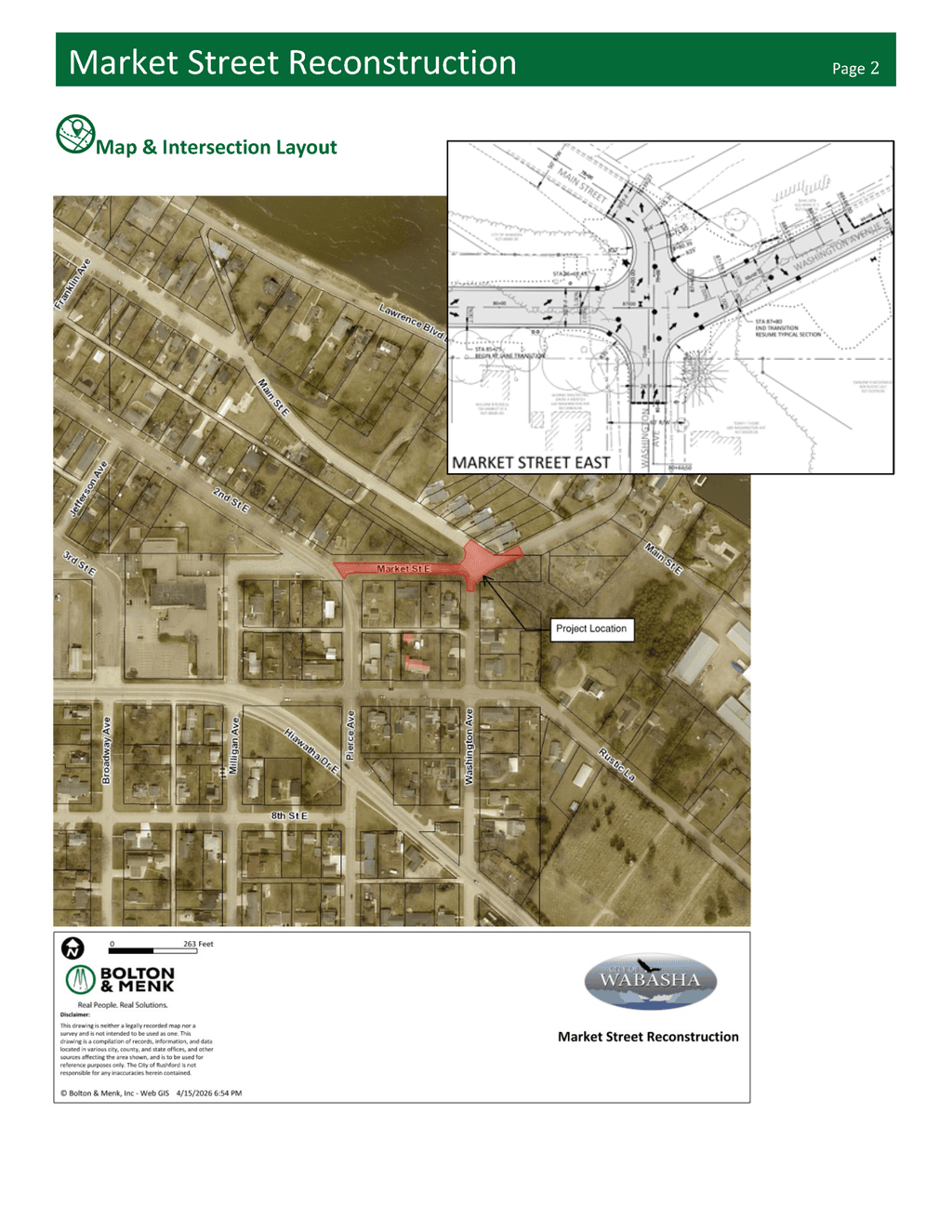
We are aware of community questions regarding potential impacts to birds in the area of the Market Street Reconstruction project, specifically the infiltration pond at Washington Street and Market and want to address how the City responded to these concerns.
4/23/2025 Update on Migratory Bird Considerations and Survey Results
The Migratory Bird Treaty Act (MBTA) is a federal law intended to protect most native bird species by avoiding impacts to active nests with eggs or young. While this project does not require any state or federal permits related to tree clearing and does not involve federal funding or approvals, the City chose to take voluntary steps consistent with U.S. Fish & Wildlife Service guidance.
Following earlier communications about the survey effort, Bolton & Menk’s qualified natural resources staff, who have extensive experience conducting MBTA nesting surveys, completed a bird nesting survey using widely accepted standard practices commonly relied upon by the U.S. Fish & Wildlife Service.
The survey evaluated the area proposed for tree removal as well as a larger surrounding area that included an appropriate buffer.
No active nests or evidence of breeding activity were found within the tree‑clearing area or buffer. Based on these results, guidance recommends that tree removal occur within five days of the survey to reduce the chance of affecting any nests that could become established after the survey was completed.
While some tree removal is necessary for this project, the City remains committed to supporting bird habitat and maintaining a healthy urban tree canopy, including planting and preserving trees in other suitable locations throughout the community.
A more detailed summary of the survey is available here: Bird Survey Conducted Detailed Summary.
Additional Background:
Under the MBTA, it is unlawful to “take” a migratory bird, including actions that would disturb an in‑use nest in a way that could result in nest failure or abandonment. Tree removal associated with the infiltration pond is not scheduled to occur until the end of the project, and if an in‑use nest is identified within the pond area or buffer, tree clearing can be timed to avoid the nesting period, consistent with MBTA requirements. The City’s construction contract also requires the contractor to comply with all applicable state and federal wildlife protection laws.
While the MBTA focuses specifically on the protection of migratory birds and their in‑use nests and eggs, this does not mean the City is unconcerned about broader habitat considerations. The City must balance environmental stewardship with the responsibility to maintain and improve essential public infrastructure. In this case, construction of the infiltration pond is necessary to ensure proper stormwater management and long‑term maintenance, while still taking appropriate steps to avoid impacts to protected wildlife.
An environmental review was not required for this project, as it does not meet the thresholds for mandatory environmental review under Minnesota rules. While agency coordination was not required as part of project approval, the City remains committed to complying with all applicable environmental laws and recognized best practices.
Additional Q and A :
Who was the qualified consultant?
Bolton & Menk has qualified natural resources technicians on staff who regularly conduct nesting bird surveys in support of public infrastructure projects and compliance with the Migratory Bird Treaty Act (MBTA). This work is a routine part of Bolton & Menk’s environmental services practice.
Barred owls are most vocal at dusk and dawn — what time did the survey occur?
The survey was conducted using established nesting bird survey practices established by qualified biologists. This included observations during times when birds were most detectable, which included early morning and dusk. The objective is to determine whether any in‑use nest is present.
Will perimeter trees, especially those not directly over the basin footprint, be retained?
Tree removal will be limited to what is necessary to safely construct and maintain the infiltration pond. Trees outside the basin footprint will be retained.
Since no nests were discovered during the survey, how quickly will the trees be removed?
Tree clearing must occur within five (5) days of the survey. If clearing does not occur within that window, a new survey would be required within five days of when clearing ultimately takes place. This is intended to address the potential for new nests to be established if too much time passes between the survey and clearing.
Why is the City constructing a stormwater infiltration pond in this area ? The area at Washington and Market currently functions as an informal infiltration area, but it lacks defined boundaries and infrastructure that can be properly maintained. A large drainage area flows to this location, making it important for Public Works staff to have a defined outlet and infiltration basin that can be inspected, maintained, and kept free of debris. Constructing a stormwater infiltration pond will improve flood containment during large storm events and, with appropriate filter media, will also enhance stormwater treatment and water quality.
What other steps is the City taking to address the trees that will be removed?
Our Public Works Department plans to plant new trees so that our urban tree canopy is not negatively impacted. This is an ongoing commitment of the City and to-date, we have planted hundreds of new trees through the City.